Tuesday, 22 September 2015

Tuesday, 15 September 2015
Decolonising the Colonised African Mind – The First 5 Steps
I have recently
been reading of and writing on many African issues. One thing that strikes me
quite strongly is the depth to which false perceptions of Africa have sunk in
our collective subconscious. While I think it is forgivable for people whose
only experience of Africa is aid adverts with awfully malnourished children and
news bulletins featuring some rabid warlord spouting maledictions – this
delusion of utter dependence should not be replicated by Africans. This is why
we have autobiographies and biographies. The person describing herself has
greater insight than the person retelling the tale. A self-portrait is not a
caricature. We Africans have flipped the script. We have reproduced the
caricature in our understanding of ourselves, in telling our stories and
understanding the heart of Africa. We have replaced the cradle of life with a
heart of darkness. So I have a 5 step solution. We need to begin thinking and
fast.
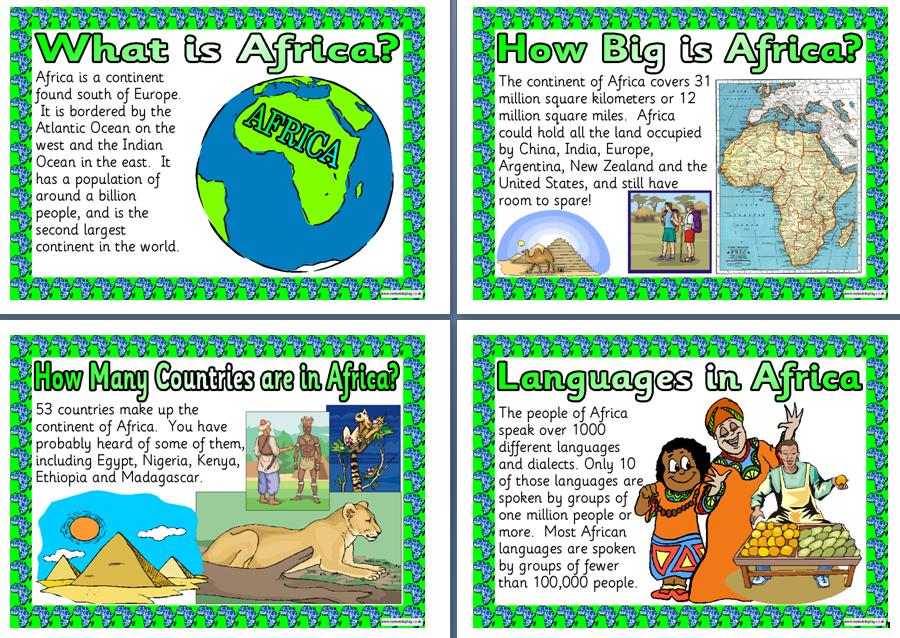
What is Africa? Take a step back from
all that has been said, especially by the media. Read the works of Africans.
Look at the Africa around you. Africa is not the few unscrupulous leaders we
have, Africa is its people. So look at its people. Africa is an eternal thought
in the mind of God. There was always Africa. Ignore the countries/states. While
I am not in favour of the breakup of states, we must remember that
nation-states are made, not imagined. The states in Africa were imagined by
people who never set foot on our tropical shores. Obama once said ‘The worst
thing that colonialism did was to cloud our view of our past.’ We need to claim
our identity as African and divorce this quest from a political one. We have bought into thinking we can truly be
what we should be by ensuring our ‘brothers’ place in political office. How’s
that working for you thus far? Go and explore, and think what it means to be Africa.
Africa was before Nigeria.
Colonisation and the sense of inferiority:
Now I really do hate to bang on about colonialism. However, let us say as an
analogy, someone scratched you with a sharp nail. Then went away. The scratch
becomes septic because the wound is not cleaned, because the damage is not
understood. Do we say the scratch is in the past and fail to treat the wound?
By no means! We may forgo pursuit of the culprit. We may refrain from a lengthy
and arduous litigation, but we do not deny existence of the wound. Make no
mistake colonialism is a wound on the psyche and insult to the soul, a
generational offense that lingers unacknowledged on the edges of our
subconscious.
Thomas Pynchon,
said, ‘Colonies are the outhouses of the European soul, where a fellow can let
his pants down and relax, enjoy the smell of his own shit.’ (Imagine!)
Our Africa was
the Petri dish in which the experiment of empire was conducted. And when the
experiment failed, the apparatus of psychological oppression hangs on in our
minds like a never-fading apparition. How did a handful of administrators
manage to shackle the African giant? By imprisoning the most important part of
a people – their sense of self-worth. By making us believe that we were
inferior, that our laws, customs ideas were of no value, thus our minds were
captured into the colonial Black Maria and our bodies soon followed. We see
vestiges of this in everyday discussions and actions: Parents failing to teach
their children African languages, people using ‘that’s what they do in London’
as a trump card in arguments, skin bleaching, naming of children, the
repugnancy principle, acceptance of non-African standards of beauty……. The list
could go on for years.
Patrice Lumumba
of Congo is famed to have said to the departing Belgian colonists ‘Nous ne
somme plus vos singes [or macaques].’ ("We are no longer your monkeys).
The truth is more complex as words are cheap. Attitudes need to change.

Self-knowledge: The first step to
changing attitudes is self-knowledge. Africans, I believe have a problem with
self-awareness and self-knowledge, especially as concerns the nature of that
self- knowledge. Arundhati Roy talks about the psychology of globalization
thus: ‘It's like the psychology of a battered woman being faced with her
husband again and being asked to trust him again. That's what is happening. We
are being asked by the countries that invented nuclear weapons and chemical
weapons and apartheid and modern slavery and racism - countries that have
perfected the gentle art of genocide, that colonized other people for centuries
- to trust them when they say that they believe in a level playing field and
the equitable distribution of resources and in a better world. It seems comical
that we should even consider that they really mean what they say.”’
The problem with
Africa is that we still trust foreign ideas more than our own. We take these
false narratives, these illusions of altruism and we internalise them and make
them our own. In the quest for a better world, we intuitively understand our
world to be worse. We make no allowance for our intersectionality. We are
black, generationally oppressed, women, men, children, poor, third world… yet
we do not speak of how these factors affect us personally. No one else can see
our pain. This pain is ours, but we swallow it, we stomach it, and let it
fester deep within us like fermenting cassava, its poisonous cyanide, killing
us from the inside. Spit it out!
Ask a hundred
non-Africans to describe Africa, there responses would be fairly similar. Ask
the same of a hundred Africans… Self knowledge unlocks the heart of Africa.
Africa defies definition, but that is no excuse not to think of her.
‘Africa is
mystic; it is wild; it is a sweltering inferno; it is a photographer's
paradise, a hunter's Valhalla, an escapist's Utopia. It is what you will, and
it withstands all interpretations. It is the last vestige of a dead world or
the cradle of a shiny new one. To a lot of people, as to myself, it is just
“home.”’ Beryl Markham
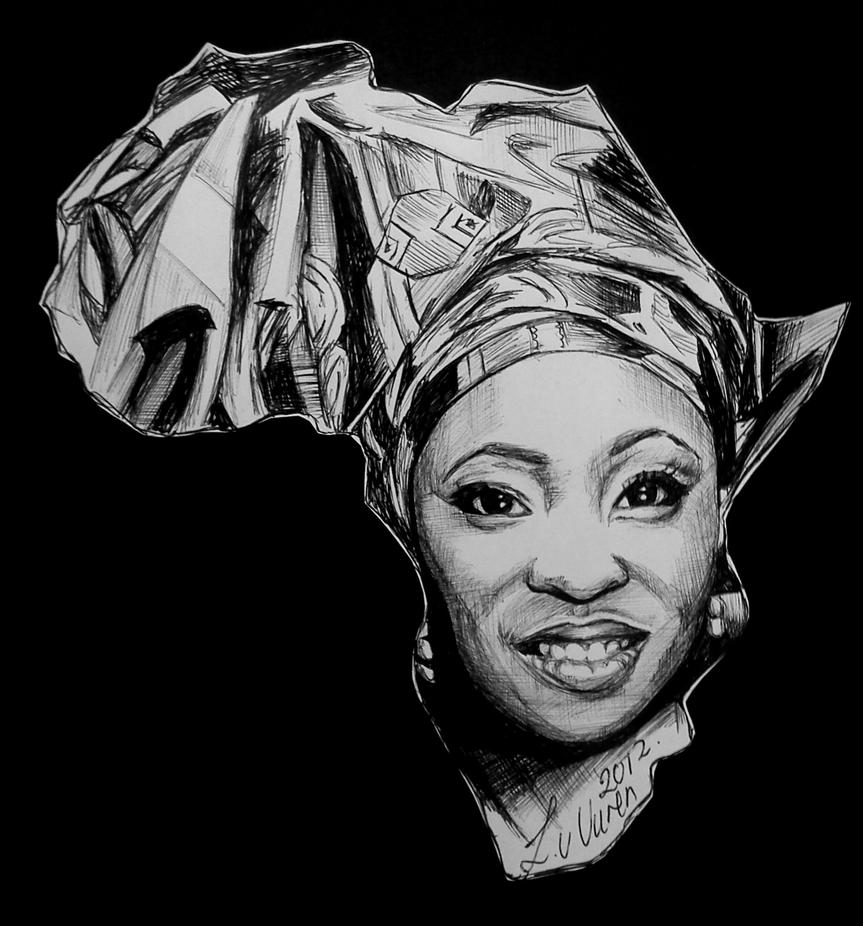
Africa is home,
I am Africa…
Historical and Contemporary knowledge:
There are very few things that upset me and annoy me as much as an African
spouting inaccurate and derogatory ‘facts’ about Africa. A multiple degree
holder once told me, ‘no African entity had ever succeeded.’ I had to
physically restrain myself, or else we would have needed industrial cleaners to
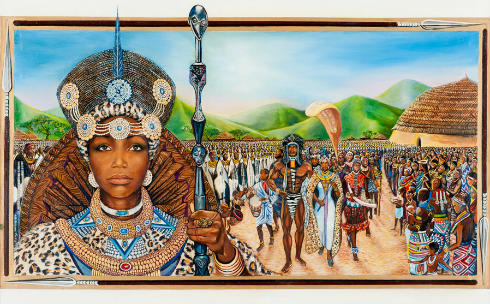
clean the blood from the walls. Did he not know of the Ghana Kingdom with its
riches in gold that existed for 1000 years? Or the Oyo Empire that traded far
and wide? Or the Buganda and Bunyoro kingdoms of present day Uganda? Or the
supposition that Africans do not know about leadership… All I have to say to
that is… Mai Idris Alooma, Nana of Itsekiri, Askia Mohammed (Askia the Great), Sonni
Ali, Shaka Zulu (kaSenzangakhona), Mansa Kankan Musa, Sundiata Keita, Alaafin
Oranyan, Cetshwayo kaMpande, Ahosu Ghezo, Asantehene Opoku Ware and ASANTEHENE OSEI
TUTU AGYEMAN PREMPEH II!!
And African
women? Oya come and read this:
Cleopatra, Moremi
Ajasoro, Iyeki Emotan Uwaraye, Efunsetan Aniwura, Queen Amina, Inikpi of
Igalaland, Taytu Betul, Funmilayo Ransome-Kuti, Queen Nzinga, Omu Okwei of
Osomari (Felicia Ifeoma Ekejiuba), Aba women’s Riot, Lagos Market women’s riot
and the Dahomey Mino (a Fon all-female military regiment).
If you don’t
know who these people are or what I am talking about, shame on all the
education systems in the world. Our history is a fact that happened no matter
what you have heard, I dare you to act like it.
Answer me these
questions:
Who discovered
the River Niger?
Who was the
first man in South Africa?
We need to be aware that schools
set up by the colonial powers were primarily set up to enable communication
between the coloniser and the colonised. In that sense they were mainly centres
of instruction. However, they have gradually become educational institutions,
though educational content in many African curricular still retains vestiges of
post-coloniality. This the point of the questions I asked above.
On the other hand, African
indigenous education emphasises training individuals to contribute to the
development of their community and the benefits of a cohesive communal life.
Conversely colonial education emphasised the value of the individual and
deemphasised the importance of community and culture. Where education seems to
isolate the individual from her community, education and its proponents become
a communal enemy. These incongruences as well as the colonial purposes of
education result in an irrelevant curricular – Shakespeare taught without
context – inherited inadequate teaching methods, and disengaged cohorts of
students.
Why do we learn Shakespeare?
Or why is cramming an integral part of our education?
Education is not entirely beneficial
if it becomes a means by which a person’s identity, culture and language
becomes obscured. Education is meant for the FULL development of the human
person – the mind, the body, the heart and the soul. Nelson Mandela once said ‘If
you talk to a man in a language he understands, that goes to his head. If you
talk to him in his language… that goes to his heart.’
We fail to learn
our own languages, sing our own songs, dances to our own rhythms, to the beat
of our hearts, to the steady thrum of our soul. The problem is that we approach
knowing from an externalised perspective. We see knowledge as something outside
of us that we have to assimilate. But it is not. We need to read more, [aim to
read a book a week – any book will do], to be more self-aware, then connect what
we have learnt with who we are, for the full development of the African
personality that lies inside of us.
As Robert Nesta
"Bob" Marley sang
‘Emancipate
yourselves from mental slavery;
None but
ourselves can free our minds.’
Word!
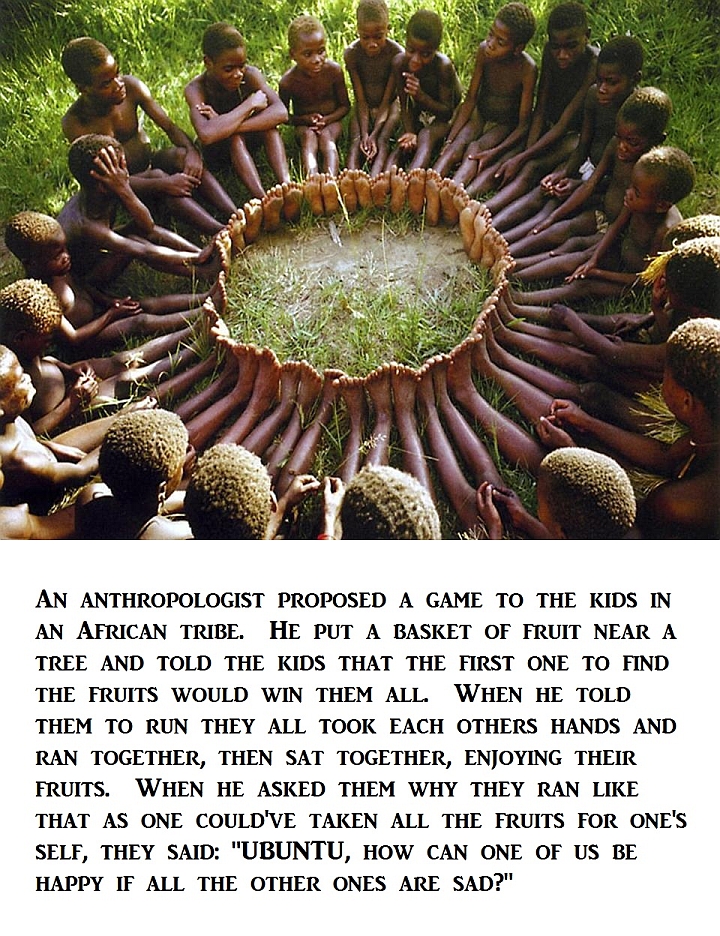
Self-esteem: The first black African
woman to win a Nobel Prize, Wangari Mathaai said ‘our people have been
persuaded to believe that because they are poor, they lack not only capital,
but also knowledge and skills to address their challenges. Instead they are
conditioned to believe that solutions to their problems must come from
‘outside.’’’
We can only shed
this innate belief when we accept the validity and worth of our existence. What
the colonised African mind suffers from is a severe case of post-colonial internalised
oppression. Even when the primary source of the oppression no longer exists, we
oppress ourselves with our own feelings of inferiority. We think anything from
‘oversea’ will be better than ‘tiwantiwa’
just by the fact of their different sources. Aba shoemaker will make fine shoe
and stamp Italy on it. As some status-conscious person once told me, even her
dead body would refuse to wear lace that wasn’t Swiss or other European origin,
to the extent that we import traditional attire. I am sure many Nigerians will
refuse to enter a car that is made in Nigeria.
On a more
psychological level and especially in the diaspora, we see many people exhibit
shame and refuse to identify as African. To this end they twist their tongues
into unimaginable shapes to produces sounds completely unintelligible, in
attempt to adopt an accent foreign to them. We call our languages vernacular, yet
these are languages of a living people, not a jargon to be hidden from the sun.
The focus on English, French
and Portuguese as languages of instruction and national communication has also
contributed to the disappearance of African languages and customs. Prof E. E. Adegbija
notes ‘Over 90% of African
languages,…exist as if they don’t really exist; they live without being really
alive. Living functional blood is being sucked out of them…’
So we live a half-life as
Africans, other people tell us what should matter to us. The West tells us we
should resist our ethnicities and cultures, our governments and their
corruption. Our governments tell us that the West is our enemy, and that our
next door neighbour is our enemy and ‘see, I built this road!’ Did they build
it with their own money?
These are the symptoms of self-oppression, not being
able to refute the fallacies around, because we fear the dark recesses of our
own minds and fear lurking in the corners of our consciousness. If we dare to,
quietly and stoutly, consider all around us, take those books off of the
shelves and learn of truth that is not really hidden, we may learn one
certainty. Our minds are being held captive by our own thoughts, that captivity
imprisons us into a life less than we were made for.
How did a handful of administrators manage to shackle the African giant? By imprisoning the most important part of a people – their sense of self-worth. By making us believe that we were inferior, that our laws, customs ideas were of no value.
How will we unshackle the African giant? By freeing our minds from mental slavery, by realizing that we are worth as much as anyone else, by eschewing narratives based on inferiority, by connecting once again with the Africa that lies inside of us - The true Africa whose heart is golden.
How did a handful of administrators manage to shackle the African giant? By imprisoning the most important part of a people – their sense of self-worth. By making us believe that we were inferior, that our laws, customs ideas were of no value.
How will we unshackle the African giant? By freeing our minds from mental slavery, by realizing that we are worth as much as anyone else, by eschewing narratives based on inferiority, by connecting once again with the Africa that lies inside of us - The true Africa whose heart is golden.

Monday, 7 September 2015
Nigeria's Democracy Delusion
Nigeria has been at the democracy game for about 15 years now and a lot of talk goes on about the ‘dividends of democracy.’ This makes it sound like democracy is some kind of equation where D (democracy) + SS (sovereign statehood) = DoD (dividends of democracy, fill in the gaps.)
So I try to work out in my head, why is Nigeria a democratic country? (and I am using the term democratic as loosely as possible, we are a civilian autocracy, or a subgroup oligarchy, a pseudo democracy, or a confusion of people led by an embarrassment of politicians but who cares about labels?) is it because we, the people, want it? The answer is no. what the people want has no impact whatsoever on the systems of government in a country. (a critical study of history will reveal this)
However, to step into the arena of international relations, a government has to prove itself to be suitably amenable to standards acceptable by the big dogs (except you have oil like Saudi Arabia, then no one will dare tell you, that you can’t be a monarchy.), it’s like when Abacha empowered ECOMOG as regional peacekeeper, (costing Nigeria millions) to keep the eyes of the world from his internal chicanery. To borrow money from the international financial institutions one has to exhibit a modicum of democracy. Then the millions are released to the leaders who spirit the money away to the ubiquitous Swiss accounts that dot the Zurich landscape.
A quick study of countries and their welfare of their people reveals that democracy is not a cure for our ills but an occlusion of our woes, while we fight the ballot box and watch for the councillors and congressmen we shove aside the true problems. While the country is wrapped in a bubble of pseudo-democracy, the world can rub its hands in self adulation while death and destruction continue within a state.
Examine the following
Am I saying no to democracy? No I am not, but making it a bench mark when it is no guarantee of rights or fair treatment is like calling a dog a cat so you can give it milk. If asked any Nigerian will tell you he/she wants security of person, food, employment; I think it is rare person who will plead for democracy. Then why are we being given a rude imitation of what we didn't ask for? I have no idea. What I know without a shadow of a doubt is that no one will give us what we want, what we need... we have to take it. We the people, are the owners of Nigeria, we should not be distracted by ethnicity to the detriment of unity. The politics of tribalism and religion is the price of our servitude.
God bless Nigeria.
A quick study of countries and their welfare of their people reveals that democracy is not a cure for our ills but an occlusion of our woes, while we fight the ballot box and watch for the councillors and congressmen we shove aside the true problems. While the country is wrapped in a bubble of pseudo-democracy, the world can rub its hands in self adulation while death and destruction continue within a state.
Examine the following
- Under a flag of democracy, the US (and several other countries) traded in human flesh, locking human flesh in the holds of vessels to endure the horrors of the middle passage, which only half of the ‘livestock’ survived. The injustice of it was continued and compounded when the south went to war in indignation when their right to keep, sell, rape, and kill other human beings was challenged.
- In 1948, by means of the popular vote in South Africa 70% of the population was forced onto 3% of the land. The world watched in relative impotence and indifference as black men and women were killed, tortured and treated like vermin.
- The largest democracy in the world, India, continues side by side with democratic government to allow untouchability and the burning of brides unable to pay their dowries.
- Germany was democratic when six million Jews were burned Auschwitz and other camps, which some politicians in democratic countries now say was a holiday camp.
- A democratic government deliberately killed 64, 000 in Nagasaki and Hiroshima tainting the land for years.
Am I saying no to democracy? No I am not, but making it a bench mark when it is no guarantee of rights or fair treatment is like calling a dog a cat so you can give it milk. If asked any Nigerian will tell you he/she wants security of person, food, employment; I think it is rare person who will plead for democracy. Then why are we being given a rude imitation of what we didn't ask for? I have no idea. What I know without a shadow of a doubt is that no one will give us what we want, what we need... we have to take it. We the people, are the owners of Nigeria, we should not be distracted by ethnicity to the detriment of unity. The politics of tribalism and religion is the price of our servitude.
God bless Nigeria.
Welcome to Lagos: A misnomer, an insult or no more than absolute truth?
(For anyone unfamiliar with the TV program 'Welcome to Lagos... Youtube/Amazon is your friend!' This is a rewrite from 2010)
Hi everyone!
The above greeting is my attempt to start this piece with a light-hearted comment, to diffuse the tensions between us, or the tensions against BBC and W2Lag (for the uninitiated that’s Welcome to Lagos). Events may have overtaken the airing of the series (the hanging of the British parliament, the cultural and allegatory crisis at the BBC, impending scrapping of the licence fee, the deletion of a Nigerian president, the clueless era, the prediction of electoral doom and purported goslowedness in 100 days ...) I hope these events may give us an objective look at the documentary.
Given the detrimental nature of exposure naija and Lagos gets usually I was quite sceptical about watching W2Lag. What convinced me to watch it was the number of FB comments on Esther and her problems with her husband. It made me wonder if the BBC was actually going to show true Nigerians and not some demonised version which seems to be imprinted in people’s head. So I watched W2Lag, from part 3 to part 1, then from part 1 to 3.
One thing struck me as profound about the series. I have been in the UK for a while now, so I guess it must have been particularly poignant for me to see everyone with a smile. In the most squalid of circumstances, everyone was smiling. And not that fake just-for-the-cameras kind of smile, but a smile that extended from the slightly askew teeth up the dusty face into the rheumy eyes, no matter the circumstances. I believe that the eyes are the window of the soul and a smile that goes to the eyes, tells of souls that are undefeated despite the situation around them, undefeated despite the fact that those who have taken oaths of office to serve the people are ready and willingly to smash the people’s homes and throw into the street the meagre collection of the people. If W2Lag achieved nothing else it de-demonised my people and for that I am grateful. I would like the whole world to know that Nigerians are not criminals or fraudsters, but a people pushed to the edge of their limits by murderous, bloodsucking and power-hungry leaders and an outside world that have grown too selfish to care. I would want all to understand that at the edge of those limits lies an untapped resource of strength, resilience, imagination and courage. God bless all true Nigerians!

Nevertheless, this does not detract from the reality that in a programme titled W2Lag, the BBC crew bypassed the airport, clean roads, and rows of palatial houses before they deigned to bring out their cameras to signal a welcome. It is the cinematographic equivalent of describing the essence of a flowering frangipani tree by studying its roots, the roots may be an integral part of the tree, but its not the part that welcomes you. On the other hand the BBC has no duty to market Nigeria and its beauties, if we don’t market, and by we, I mean our epileptic non-government which grows fat on the flesh of children and distracts us by fomenting strife among those who should join together and kick the unmentionables out of office and existence.
This link is a letter written by the Nigerian High Commission to the UK addressed to BBC. The letter laments the fact that the BBC did not set itself up as an advertising agency for the work that Fashola is doing. In addition to these sort of presumptuous statements, the letters contains such elementary errors as substituting the word “slums” with “slumps” and “scanvage” instead of “scavenge.” The second example clearly showing that, the high commissions computer either does not have spell-check or the 'Seke' doesn’t know how to use it. (The latter reason is most likely as he/she probably got the job as per who-you-know and not what-you-know. In this case not much.) The letter says that this documentary is a distortion of life in Lagos. And thereby they deny the existence of a large percentage of the population of Lagos, and the rights they have to a better society to be provided by our inept, inadequate and demented government.
Of all the sinners at the table of W2Lag; BBC, Nigerians and the Nigerian Government; the greatest sinner in my opinion (as you may have surmised from my restrained descriptions) is the Nigerian government. The government’s reaction to the documentary is irrational, illogical and moronic. As for BBC, they do what they want to do and always get away with it, but in this instance they seemed to have inadvertently captured the hearts and lives of people we will hardly ever see on international TV, evoking with clean cinematography and an almost flawless soundtrack the complicated nature of lives and dreams of SOME people in Lagos. Maybe we should not ask a biased, ex-colonial for more than that, after all “Nous ne sommes plus leur singes.” And as for until we learn and are able and free to tell our own stories, it is to the Esthers, Vocal Slenders and Zagedes that we look to, to speak our heart, to tell of our realities and to be to the world, the real Nigeria.

Stronger Than Hate
The history of humanity seems to be defined by human eyes
looking away...
Looking away from dead bodies floating in the water,
Looking away from people trapped in steel cans,
Looking away from dead bodies,
Looking away from people turned to blood and bone,
Looking away from people turned smoke and dust,
Looking away, looking away from dead bodies...
Always we look away, turn away, go on with our day,
Guard jealously our plate...leave them to their fate...
Let's leave them to their fate,
They died long before,
Long before their breathing ceased,
Long before their blood was shed,
Long before the bombs and the fire,
Long before the waters bore them away,
They died from indifference much stronger than hate.

looking away...
Looking away from dead bodies floating in the water,
Looking away from people trapped in steel cans,
Looking away from dead bodies,
Looking away from people turned to blood and bone,
Looking away from people turned smoke and dust,
Looking away, looking away from dead bodies...
Always we look away, turn away, go on with our day,
Guard jealously our plate...leave them to their fate...
Let's leave them to their fate,
They died long before,
Long before their breathing ceased,
Long before their blood was shed,
Long before the bombs and the fire,
Long before the waters bore them away,
They died from indifference much stronger than hate.

Wednesday, 15 July 2015
My Argument Proposing the Motion to End Aid to Africa
(So I am going to be doing this
in the format of my old primary and secondary school debates. I will not start
with ‘Good day’ however, because Mr Olasehinde said it sounds rude!)
Hello my fellow Africans, valued
(so not!) statesmen, honourable(?) financial analysts impeccable (cough, cough!)
policy makers and the esteemed citizens of the world (audience). I am here to
propose the motion that no aid should be sent to Africa, from this day forward,
forever, amen. My points are as follows:
Great men, like Albert Einstein,
Benjamin Franklin and David Boswell, have been attributed with the honour of defining
insanity as ‘doing the same thing over and over and expecting different results.’
Irrespective of who said it, at the core of the statement lies a truism. Since
circa 1960 and the creation of African states in an arbitrary and haphazard
manner, that disregarded the needs and desires of the African people, aid has
poured into the continent like water into a basket. He who pours water into a
basket shows where exactly his level of common sense lies. There has not been a
proven empirical link between aid and growth/development. No African state can
be proven to have developed strictly because of the aid received.
The purposes of giving aid have
always been dubious. During Nigeria’s civil war, it has been stated that the
aid given to Biafra extended the length of the conflict for over a year, thereby
increasing the number of dead and wounded. The activities of aid agencies in
the continent are hardly ever in concert with actual development. The proportion
of overall aid dedicated to technical assistance, emergency food and health
aid, as well as debt forgiveness, is relatively low. These forms of aid are
logical in the short term. However, project and program aid has not been shown
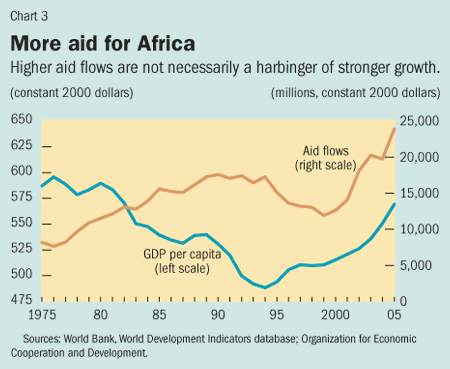
to make a massive difference to the lives of African people. In actual fact, as
the amount of aid started dropping due to the financial crisis in Europe and
America, the GDP of African countries began to increase. There has to be a
systematic reduction in health aid, coupled with technical assistance that
leads to an infrastructural improvement in African states.
Let’s move to the structural
adjustment programs of the 1990s, when we all joked that life was being SAPped
out of us. Do you remember? The IMF and World Bank programs caused a lot of
suffering in many African nations, slashing spending on health care, education
and agriculture. Were these cuts meant to be made up by aid? Any solution that
ignores the root cause and logic is no solution at all.
Rather than aid, governments of
developed countries should make policy changes to enhance African development. John
Hilary, executive director of War on Want, cites trade liberalisation policies
that subject firms in poor countries to competition they cannot handle and tax
loopholes that allow firms to minimise payments to developing countries. Dani
Rodrik, the development economist, says rich countries should pursue a "do
no harm" approach with policies that include carbon taxes and other
measures to ameliorate climate change; more work visas to allow larger
temporary migration flows from poor countries; strict controls on arms sales to
developing nations; reduced support for repressive regimes; and improved
sharing of financial information to reduce money laundering and tax avoidance. Note
that some aid is actually in the form of loans that contribute to Africa’s debt
crisis. Basically give 1 carrot with the left hand and collecting 2 with the
right hand.
Secondly, the Wolof of Senegal
say that ‘a dish which is going to be tasty will smell good when it boils.’
However, the stench of aid clings to Africa like a beggars rags. I heard
someone say something on TV in the UK implying that Africans should have picked
themselves up after all the money she has given us. The Yoruba people say that
it is for the day of trouble that each person has a unique name. I would have like
to have told that woman that no aid had ever come to me. Let’s take a few
examples of where aid actually goes…
Aid to Morocco was used to fund L’Oasis
de Noria – a vast £60million holiday complex comprising a lagoon complete with
waves, a golf course, almost 1,000 apartments and villas. £800,000 was given by
EuropeAid, which Britain significantly funds.
Yegna, a girlband dubbed the
Ethiopian ‘Spice Girls’, was given £3.8m by the UK Department for International
Development.
Iraq receives the largest proportion
of US aid.
Due to the greed and therefore
corruption of many African leaders, a large proportion of aid goes missing. Conclusively,
aid hardly enriches the lives of a large proportion of Africans, most
especially, those who need it. If aid were not given, the lazybones leaders who
are waiting for handouts, will make something of their countries and actually
make more money. Idiots!
Thirdly, the Somalis say that ‘Bad
counsel may cause you to fall into an abyss.’ The motivation for giving aid by
developed countries is questionable and the statistics upon which the motivation
is based is unverifiable. The British PM said that if aid is not given ‘the
problems of conflict, the problems of mass migration, the problems of
uncontrollable climate change are problems that will come and visit us at home.’
Again, this motivation has proved futile as, African migration via the Mediterranean
has reached a high in 2015.
We can look back through African history
as to how aid has been used. Let us go to 1958. When General Charles de Gaulle
assumed supreme power in 1958, an independence referendum was held in the African
colonies. Guinea-Conakry alone voted for independence; France responded by
granting Guinea independence in 1958 but withdrawing its officials and its
financial aid.
The reluctance to grant aid is
also worrisome. Since 1970, when the world’s rich countries agreed to give 0.7%
of their Gross National Income as aid yearly, targets are rarely met. The US is
often the largest donor in monetary terms, but ranks amongst the lowest in
terms of meeting the 0.7% target. The Ethiopians say ‘A bird hanging between
two branches will get bitten on both wings.’ You either give aid or you do not.
You either give for the right reasons, or you do give at all. (See my carrot
and hand analogy above.)

Fourthly, while the percentage amount
of aid is negligible, the fact of aid confirms Africans (and therefore black
people) as helpless and subhuman in many people minds. This feeds into the intractableness
of racism in the world today. British politician, Peter Mandelson said that aid
has ‘demeaned many African governments by turning them into professional
beggars.’ Every aid advert on television is accompanied by bony African children,
with flies on their eyeballs. For many, many people, these are the only Africans
they will ever see.
Now let’s look at colonialism. The
colonial powers managed to convince themselves that they were subjugating
Africans (and others) for their own good. European violence was
going to stop the wars endemic to Africa, and their enlightened (over-)rule
would be to the benefit of all. (Sound familiar?) Enough is enough. E don do!
The Ewe of Ghana say that ‘a
beggar can beg for certain things but cannot beg for an ostrich's egg.’ Our self-worth
cannot be maintained while presidential begging subsists. The Fulani of West
Africa say that ‘He who gallops the horse of greed arrives at the door of shame.’
The horse of aid will only lead Africa to more shame. The Swahili say that ‘when
the crocodile smiles, you should be extra careful.’ Collecting aid is no aid.


The Akan of Ghana say that ‘When
you grab the head of a snake, the rest is mere rope.’ This problem and the
solution is in African hands. African can and should care for itself. Africa
has 58 countries and 1 billion people. Now I am going to give you some critical
information.
The export of African forest
products from Cameroon, Central African Republic, Republic of the Congo,
Democratic Republic of the Congo, Gabon, and Equatorial Guinea, brings in
significant revenue. Africa’s fishing industry, mainly coastal West Africa, Namibia
and South Africa, provides income to more than 10 million people and has an
annual export value of $2.7 billion. African inland fisheries contain more than
3,000 fish species and account for two-thirds of global inland fish production.
Lake Victoria is the most productive freshwater fishery in the world,
producing more than 500,000 tons of fish worth $600 million every year. Africa’s
agricultural products include cocoa (which alone accounts for 70% of the
continent’s agricultural exports), coffee, tea, cotton, sugar, pineapple and
bananas. Over the period of 2000 to 2011, West Africa recorded a large trade
surplus of coffee, tea, cocoa and spices, which rose from just below US$ 2.5 to
7.5 billion. However, African products are largely unprocessed products (less
than 6% of African cotton is processed, and only 25% of cocoa), as most of the
processing is done in importing countries.


The Aswan Dam, a complex of two
dams in Aswan, Egypt, captures the world’s longest river, the Nile, in the
world’s third-largest reservoir, Lake Nasser. The Aswan High Dam, the
newer and larger of the two dams, produces more than 10 billion kilowatt-hours
of electricity every year, enough power for about 15 percent of the
country. Lagos is Africa’s second most-populous city, with a population of
about 10.2 million people. Lagos is growing 10 times faster than New York City,
New York, or Los Angeles, California, in the United States. The United Nations
estimates that Lagos will be one of the largest megacities in the world by
2015.

The Cold War illustrated that whoever controlled Africa, controlled the world. China’s association with Africa attracts caution, for this reason. Despite its resources, with the exception of cocoa, for which Africa is the main producer, the continent is unable to influence international prices (price taker). Imported products represent 1.7 times the value of exports. Exportation is actually done at a loss, which is why dependence on aid is required. According to the World Bank, just 5% of Africa’s cereal imports come from other African countries. It is estimated that more than 60% of the world’s available and unexploited cropland is located in sub-Saharan Africa. Africa can feed the world.
Africa and its countries need to
look inwards. Africa needs to close its borders to resources. Nothing comes in,
nothing goes out… for 5 years. During that time all Africa’s resources should
be used to develop Africa and Africa only. While human resources cannot be
conscripted, the more Africans who dedicate their time and skill to this
project, the better. ‘When there is no enemy within, the enemies outside cannot
hurt you.’
The Setswana of Botswana say that
‘life, like a wheel, turns.’ Africa can develop and turn poverty into wealth.
We should also not ignore the good
and beneficial teachings in our culture. As the Yoruba say. ‘If we stand tall
it is because we stand on the backs of those who came before us.’
With these few (ahem) words of
mine I hope I have been able to convince and not confuse you that Aid to Africa
should stop now.
We are what we think
We are here!
We are proud!
We are free!
We are Africa!!!

Subscribe to:
Posts (Atom)