Saturday, 26 March 2016

Wednesday, 16 March 2016
Tuesday, 12 January 2016
Darius Simpson & Scout Bostley - "Lost Voices" (CUPSI 2015)
"You know nothing of silence until someone who cannot know your pain tells you how to fix it."
Monday, 21 December 2015
The ‘Failed State’ as a Doubly False Categorisation of Nigerian Statehood
Nigeria has
often been described by scholars, commentators, journalists and some statesmen
as a ‘failed state’. This designation is based on a faulty appreciation of the
understanding of what a state is in international law and what it means for a
state to fail within international politics. This paper will examine the concept
of failed states and explain why there is a conceptual error in categorisation
and suggest further steps that need to be taken by Nigeria – its people and its
leaders.
The Argument for Nigeria as a Failed State
Because states
were ostensibly created for the complete security of those who live within that
state, when its peoples’ security is not observed the state would be said to
have failed; for example, the failure to protect human rights is a malfunction
of state.
According to
Kaufmann and Kraay the crux of good governance is ‘a capable state that is accountable to citizens and operating under
the rule of law.’[1] The International Monetary
Fund and the World Bank encourage good governance that can be achieved through
accountability, political stability, adherence to the rule of law, government
effectiveness, ability to promote private sector development, transparency and
eradication of corruption.[2]
Therefore, if we conclude that Nigeria has the opposite of good governance as
defined by Kaufmann and Kraay, we mean that the government is incapable or
failed; the government is not accountable to its people and does not operate
under the rule of law. There have been several instances of this in Nigerian
history. Firstly, there is the high number of unconstitutional changes in
government which contravene the rule of law. Secondly, a state is said to fail
or be collapsed ‘when it no longer
performs the functions attributed to it.’[3] Nigeria is a failed state
according to the Failed States Index 2014; it is ranked 17th on the
list of failed states.[4]
The concept of
state failure is a matter of functional collapse, i.e. state malfunction or
non-function, when a state is not able to perform the fundamental functions
attributed to it by scholars like Hobbes. According to the Failed States Index,
Nigeria states suffers mostly from factors such as delegitimization of the
state, demographic pressures, insecurity, human rights abuses, inadequate
public services, group grievance, factionalized elites, external intervention and
uneven development. This argument, however, fails to take account the nature of
the post-colonial state in Africa, of which Nigeria fits the general profile. It
is on the basis of state criteria that some may suggest that Nigeria is
‘failed’.[5] ‘A
state, defined as the authoritative political institution that is sovereign
over a recognized territory, fails when it no longer performs the functions
normally attributed to it.’[6]
What is not addressed, based on the same
criteria, is whether Nigeria is a ‘state.’ Coupled with what could be seen as a
relaxation of the traditional criteria for statehood at decolonization, the
emergence of the additional criteria has resulted in some post-colonial states
to be classified as failed states.[7] What
that means is while failure is clearly proven, statehood is not.
The Creation of States in International Law
Initially
humanity existed in communities which later evolved into kingdoms and empires.
The complexity of human existence occasioned the move of world society from
existing in stateless forms to requiring a sovereign state for security.
The classical
criteria for statehood is listed in Article
1 of the Montevideo Convention 1933 as follows: permanent population;
defined territory; government; capacity to enter into relations, i.e.
independence.[8] Some additional suggested criteria include: the
protection of human rights; external recognition; and effectiveness.[9]
In fact of the
classical criteria of statehood, recognition and territory are the only
conditions clearly attained by Nigeria;[10] in the case of territory,
even though it is clearly defined it is not completely accepted by those within
those territories.[11]
According to Kreijen[12]
state attainment in sub-Saharan African was achieved by a ‘legal trick’ which involved the abandonment of ‘effectiveness.’ Therefore according to his theory,
Nigeria was created and recognised outside the classical method of creating
states which led to inefficient pseudo-states which inevitably failed. Somewhere between the fleeting transition from
colonies to states, there was a legal and political mishap.[13] The disintegration of governmental control
reduces the strength of the peoples’ allegiance to a state, and in fact the
belief in citizenship and the rights and duties it entails become a hollow
confidence forcing people to re-align along religious or ethnic lines.[14] In
actuality, a state never really existed and there was nothing to pledge
allegiance to.
Even though
Kreijen’s theory works from logical historical premises to achieve a seemingly
rational conclusion, nevertheless he accepts African states as states, though inevitably
failed. It posits therefore that what was not in existence can be created by
relaxed rules and engendered by recognition. Therefore, while it asserts that
the states are not states stricto sensu,
it suggests that they were created as ineffective states doomed to failure.
This theory operates from the conception that state failure induced the reduced
allegiance to the state,[15] it
does not consider the fact that there was lack of allegiance to the state by
the citizens and the government; that by attributing that same allegiance to
the ethno-linguistic or ethno-religious group rather than to the state, the
state disintegrated immediately it was integrated. Furthermore, from Langford’s
definition[16] a
state is failed when it, as a sovereign entity, can no longer
perform the functions of statehood. The problem is that the states never
performed the functions of statehood prior to decolonisation, and have had
difficulty in doing so thereafter. The classification becomes increasingly problematic.
The
classification problems arise from using a hybrid of circular reasoning and
definition. ‘An argument is circular if
it couldn't possibly convince someone that the conclusion is true if they
didn't believe the conclusion already.’[17]
The definition of failed state is only convincing because we all accept, at a
very fundamental level that Nigeria is a state. Conceptually and logically, we
have no reason to do so.
Due to the
classification inadequacies of post-colonial African states in conflict as
failed states, the opinion of some is that there are rather quasi-states having
not been states abinitio.[18]
Because Nigeria was the creation of colonialism and decolonisation, as a post-colonial
state Nigeria lacks the same impetus for being a state that kept the same
territory adhered as a colonial entity. Note that the functions of colonies
differ from the function of states. The administrative system in place in
Nigeria pre-1960 was to fulfil colonial functions. These colonies were run by
experienced colonial administrators prior to decolonisation, as post-colonial
states, governance was handed over to those who had not been leaders of
pre-colonial entities and who had little experience in administration.[19]
Furthermore, the speed of decolonisation resulted in chaotic state
administration,[20]
this led to what may be called the failure
of quasi-states or non-states. This failure is due to the inherent
imitation of post-colonial states of other non-colonial states with little or
no resort to indigenous methods or needs of government or politics.[21] The
lack of effectiveness that Kreijen adduced to sub-Saharan states is exhibited
by the following signs:
- The
central government’s authority is weak and doubtful,
- Government
is ineffectual and riddled with corruption,
- There is segmentation of the community and society into various publics and political allegiance is divided along those segments.[22]
Mazrui described
the failure of the African state as being characterised by lack of sovereign
control over territory; ineffective revenue extraction, inability to maintain
national infrastructure or provide social services or maintain law and order.[23]
Jackson has
related the corruption of government to the perpetuation of the legacy of
colonisation whereby state resources were colonial resources; in the
post-colony they become private resources. This is why government in Nigeria
became a source of privilege and power for a select portion of the populace
rather than the means by which the people of the state access ‘law, order, security, justice, or welfare.’[24] The interpretation
and meaning of sovereignty, classical or modern, has little impact on this type
of state structure, internal conflict seems inevitable and development and
positive peace is dependent on restructuring Nigeria’s political systems.
Nigeria’s Future?
Nevertheless,
despite the theoretical and/or overt ineffectiveness of Nigeria as a state, any
attempt to effectively and legally question its statehood would be met with
opposition internally and externally. The state has been extant for 55 years
and has been recognised by other states in Africa and in the world. Nigeria has
been admitted into the UN and has completed treaties of various sorts with
other states, institutions and organisations. In other words Nigeria is
externally functioning as a state. On
the other hand, the inherent problems of questionable statehood are exhibited by
the inadequacy of internal functioning which results in underdevelopment,
instability and insecurity. Nigeria exists in sufferance and while not
possessed of effectiveness, the state has title to territory that suffices and
was an expedient step in decolonisation.[25] Title to territory enables
the sale of petroleum and other natural resources.
Nevertheless,
Nigeria is unable to secure its people, it therefore cannot provide ‘political
goods’ to its people, most specifically, economic and physical security.[26] The
problem with Nigeria as a sovereign state is that its nature lends it easily to
internal failure and volatility. Ironically, a state which is completely
effective but was created by means unaccepted by international law would not be
recognised as a state,[27] conversely,
because Nigeria was created by an acceptable means – decolonisation – though
largely ineffective, it is protected by the cloak of sovereignty.
Because a
government should derive its legitimacy from the people as a cohesive whole and
be accountable to the people as an indivisible unit, a skewed relationship
between people and government, in a properly functioning state, should affect
the relationship between the government and the international community. Due to
the tenuous nature of international community especially the equality of states
at the UN, any attempt to alter the standard of relations is frowned upon as an
attack on sovereignty and quickly shuffled into the background. The conception
of state has become rigid in policy and theory while it remains fluid in
actuality.
Therefore, the
responsibility for the creating the Nigerian state, ideologically lies with the
people. The people need to take charge of their own destiny. The state has to
be built from the grassroots.[28]
Ultimately, it is for the people to take back their identity and hold the
government to account when it fails to protect their dignity. At present the
international community through the conceptualisation of states in
international law is impeding this process. While encouraging people to vote is
commendable, a populace whose understanding of democracy is limited to
political participation as only achievable by voting, will not ensure a
credible democratic process. Governments that only have to convince the
international community that elections were ‘free and fair’, will not be
constrained to ensure the security of the people is protected.
One example of how the nation
can be built by the people is in the area of law-making. Most laws in Nigeria
are passed due to self-interest or external pressure, and the passage of
significant bills is usually preceded by lack of consultation and the need to
pass a quota of bills into law.[29]
Very few of these bills originate, from pressure groups, or community leaders. This
should change.
The immobility
of ideology about Nigerian statehood and community allegiance needs to be
confronted, but this can only be done efficiently, when the need for it is
realised, from within. Constitution of political parties also needs to be taken
out of the hands of the political elite. Presently, the creation of political
parties either centres on ethno-linguistic groupings or concentrations of
power.[30]
In that sense, civil society needs to be reinvigorated from the grassroots,
local government should also be receive more attention and the central
government’s political importance to the people de-emphasized. On all spheres,
local, national and international, there needs to be an attitudinal and
paradigmatic alteration that eschews conceptual stagnation and focuses on human
security. Human security involves a paradigm shift from the ‘focus of security to the ability of
individuals to live, rather than states to exist.’[31]
It is a mechanism ‘to protect the
vital core of all human lives in ways that enhance human freedoms and human
fulfilment.’[32] In
other words, it does not matter what you call Nigeria, as long as her people
are allowed to live free fulfilled lives.
[1] Kaufmann, Daniel, and Aart Kraay.
"Governance Indicators: Where are we, where should we be
going?." The World Bank Research Observer 23.1 (2008):
1-30, 1
[2] IMF Fact Sheet “The IMF and Good
Governance” 1 – 3; World Bank Institute (2008) “Governance Matters 2008:
Worldwide Governance Indicators 1996–2007” URL: http://info.worldbank.org/governance/wgi/pdf/WBI_GovInd08-5a.pdf
[3] Langford, Tonya. "Things fall
apart: state failure and the politics of intervention." International
Studies Review (1999): 59-79, 64; Ahluwalia, Pal. Politics and
Post-Colonial Theory: African inflections. Routledge, 2012, 53
[5] Bøås, Morten, and Kathleen M.
Jennings. "‘Failed States’ And ‘State Failure’: Threats or opportunities?" Globalizations 4.4
(2007): 475-485, 476, 478, 482; Coyne, Christopher J. "Reconstructing Weak
and Failed States: Foreign intervention and the nirvana fallacy." Foreign
Policy Analysis 2.4 (2006): 343-360, 357; Rotberg, Robert I. "The
New Nature of Nation‐State
Failure." Washington Quarterly 25.3 (2002): 83-96, 91
[6] Langford (1999) 64
[7] Kreijen, Gerard. State
Failure, Sovereignty and Effectiveness: Legal lessons from the decolonization
of sub-Saharan Africa. Vol. 50. Martinus Nijhoff Publishers, 2004, 142-143
[8] Kreijen (2004) 18-23; Jackson,
Robert H. "Quasi-states, Dual Regimes, and Neoclassical Theory:
international jurisprudence and the Third World." International
Organization41.04 (1987): 519-549, 529
[9] Crawford, James R. The
Creation of States in International Law. Oxford University Press, 2006.
[10] Kreijen (2004) 147; even these
could be doubtful considering the porosity of Nigeria’s borders
[11] For example - Bakassi
[12] Kreijen (2004) 148
[13] Kreijen (2004) 162
[14] Langford (1999) 62
[15] Rotberg (2002) 90
[16] Langford (1999) 64
[17] Sober, Elliott Core
Questions in Philosophy: a text with readings. Macmillan, New York, 1991.
183
[18] Jackson (1987) 526
[19] Jackson (1987) 526; Langford
(1999) 63
[20] Kreijen (2004)167
[21] Langford (1999) 63
[22] Jackson (1987) 526-527
[23] Mazrui, Ali. "The African
state as a political refugee." African Conflict Resolution (1995):
9-10.
[24] Jackson (1987) 527
[25] Jackson (1987) 531.
[26] Rotberg (2002) 91
[27] Okafor, Obiora Chinedu. Re-defining
legitimate statehood: international law and state fragmentation in Africa.
Vol. 36. Martinus Nijhoff Publishers, 2000, 67; Somalia and Kosovo.
[28] Teffo, Joe. "Democracy, Kingship,
and Consensus: A South African perspective." A Companion To
African Philosophy (2004): 443-449, 445.
[29] Ewuim, N. C., D. O. Nnamani, and
O. M. Eberinwa. "Legislative Oversight and Good Governance in Nigeria
National Assembly: An Analysis of Obasanjo and Jonathan’s Administration."
147.
[30] Wamala, Edward. "Government
by Consensus: An analysis of a traditional form of democracy." A Companion
to African Philosophy (2006): 433-442, 440-441.
[31] Owen, Taylor. "The Critique
That Doesn't Bite: A Response to David Chandler’s Human Security: The Dog That
Didn't Bark'." Security dialogue 39.4 (2008): 445-453,
447
[32] Cited in Owen, Taylor. "The Uncertain
Future of Human Security in the UN." International Social Science
Journal 59.s1 (2008): 113-127.,118
Why We Should All Love Athletics: A Metaphor for the Human Spirit
For the avoidance of doubt in this blogpiece 'Athletics' means ‘competitive running, jumping, throwing, and walking.’

.jpg)


[1] Here comes a lion. This is about the first thing you hear in the Lion King [1995]
So it is the end of a year of ups and downs for athletics – a fantastic IAAF world championships in Beijing and a new chairperson to head the IAAF, but doping sits among these achievements like 20 uninvited ex-girlfriends frowning in the front row at the wedding reception. However, I still believe we should all love athletics. My arguments will be swift and to the point [ahem!]
Athletics is the biggest sport in the world: The IAAF [International Association of Athletics Federations] has 213 member nations. The United Nations has 193 member states and a handful of observer states. This means that the IAAF is the most representative international organisation in the world. [The International Olympic Committee has 133 members in total]
Athletics is the oldest and purest sport in the world. I remember my Phys. Ed. teacher in school [USS], Mr Aina, once described a day in the life of a caveman.... Mr Caveman wakes up in the morning, and goes to look for his breakfast. Remember, of course that he is a hunter-gatherer. So taking up his spear [javelin] he jogs out into the bush. He spies the backside of a sleeping antelope. He stealthily creeps up behind it, till he is quite close… then he HURLS HIS SPEAR!!! Alas, it was not an antelope, but a lion. Mr Caveman FLEES! The lion follows in hot pursuit. To stay alive, Mr C has to outrun the lion. The lion is gaining on him, but the caveman picks up speed. You can hear the heavy, padded footfalls of Leo the Lion. Mr Caveman jumps over a small bush at top flight. The lion demolishes the bush! The caveman tries to outwit the lion by flinging himself maniacally over a large pit he had previously dug as a hunting trap. The lion speeds around it. Mr Caveman is thinking about who will inherit his bone collection, but refrains from such morbid thoughts when he sees the smoke arising from the settlement. He screams ‘NANTS INGONYAMA BAGITHI!!![1]’ at the top of his voice, as the villagers rush to close the gates. Mr Caveman vaults with the aid of his spear as a fulcrum to the ground, launches himself over the 5-foot wall – an Olympic all-rounder!
More than any other sport athletics teaches perseverance. The world today suffers from a surfeit of perseverance. Most athletes are in the game for the experience, because compared to other sports the rewards are measly. But they keep coming back…. In the running, the jumping, the throwing – you feel truly alive.
There are some great characters in athletics. I will not dwell on Usain Bolt, though he seems to poster boy for athletics. [Sorry Usain!] I believe the weight placed on him is too much for one person. There other names that should symbolise the spirit of athletics.
Julius Yego: Kenyan javelinist, who realised he was too slow to keep up with the distance runners and moved to the field event. He is mostly known for watching videos of athletes such as Jan Zelezny and Andreas Thorkildsen on YouTube to help with his technique. At the 2015 World Championships he won the gold medal with a throw of 92.72m, becoming the first Kenyan to win a World Championships gold medal in a field event. Who have to find what you are good at, you may have to look for unconventional means to get better, try everything.
Blanka Vlašić: Croatian high jumper. Once had an unbeaten streak of 34 competitions. While she is not the world record holder, she has successfully cleared 2 m more times than anyone in her event. Prior to the 2015 World Champs, she had to walk with the aid of crutches, but still won a silver medal at the World Championships. She was so delighted with it. She is an example of perseverance, if you want something, there is just one guarantee – if you do not try, you will not get what you want.
Wayde van Niekerk: South African 200m and 400m. One of my favourites. He has the fastest non-American time for the 400m. His place in this piece was cemented by his performance in the 400m finals at the 2015 World Championships. Prior to the final the focus had been on former world champion LaShawn Merritt and reigning Olympic champion Kirani James. I had seen van Niekerk run a blistering 300m earlier in the year, and I thought if he could hold on he would get a medal in the 400m World Champs finals. He went two better and got the gold. Merrit and James could just not catch him! He had to be taken away on a stretcher following his exertions. I do not think I need to expand too much on the lessons here, but – leave everything on the field of play, you cannot be rewarded for what has not been put into play.

Valerie Adams is a shot putter from New Zealand. She is a four-time World champion, three time World Indoor champion and two-time Olympic and three-time Commonwealth champion, and currently holds the New Zealand, Oceanian, Commonwealth and equal World Championship records. Her complete international medal collection will transform the finances of many small and medium state economies [19 gold, 5 silver]. If you are good at something, keep doing, focus on your strengths, not on what the world likes to see.

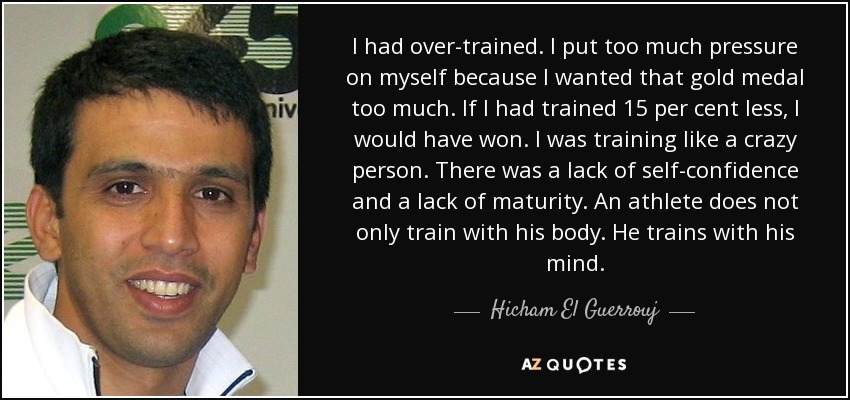
Hicham El Gerrouj: Moroccan middle-distance runner. He is the current holder of the 1500 metres, mile and outdoor 2000 metres world records, as well as a double Olympic gold medallist. I have taught classes on perseverance with this man’s CV. In 1996 at the Atlanta Olympics, he was tipped to feature prominently in the 1500m final but fell down with about 400m to go. At the Sydney Olympics in 2000 he finished 2nd in the 1500m final to the person who acted as pacemaker for his world record. In 2004, knowing that he was almost at the end of his abilities, he was billed to run both the 1500m and 5000m at Athens. A huge ask for someone who had twice failed to win an Olympic gold and had a relatively poor start to his 2004 season. In the 1500m El Guerrouj narrowly beat Lagat by 0.12 seconds to win gold! 0.12 second win in the 1500m!!! Four days later El Guerrouj won the 5,000 m beating the great Kenenisa Bekele to 2nd place. Keep fighting for what you want, do not give up till you have laid hands on all you possibly can.
I hope I have convinced you that athletics is not all about doping, it is not just about the 100m – the decathlon has TEN track and field events! Athletics is about human character, it is a showcase for the human spirit, a display of perseverance, determination and speed. Athletics is about making the mind the master of the body. Athletics is a microcosm of humanity. We should all love athletics, because we should all love humanity.
[1] Here comes a lion. This is about the first thing you hear in the Lion King [1995]
Subscribe to:
Posts (Atom)